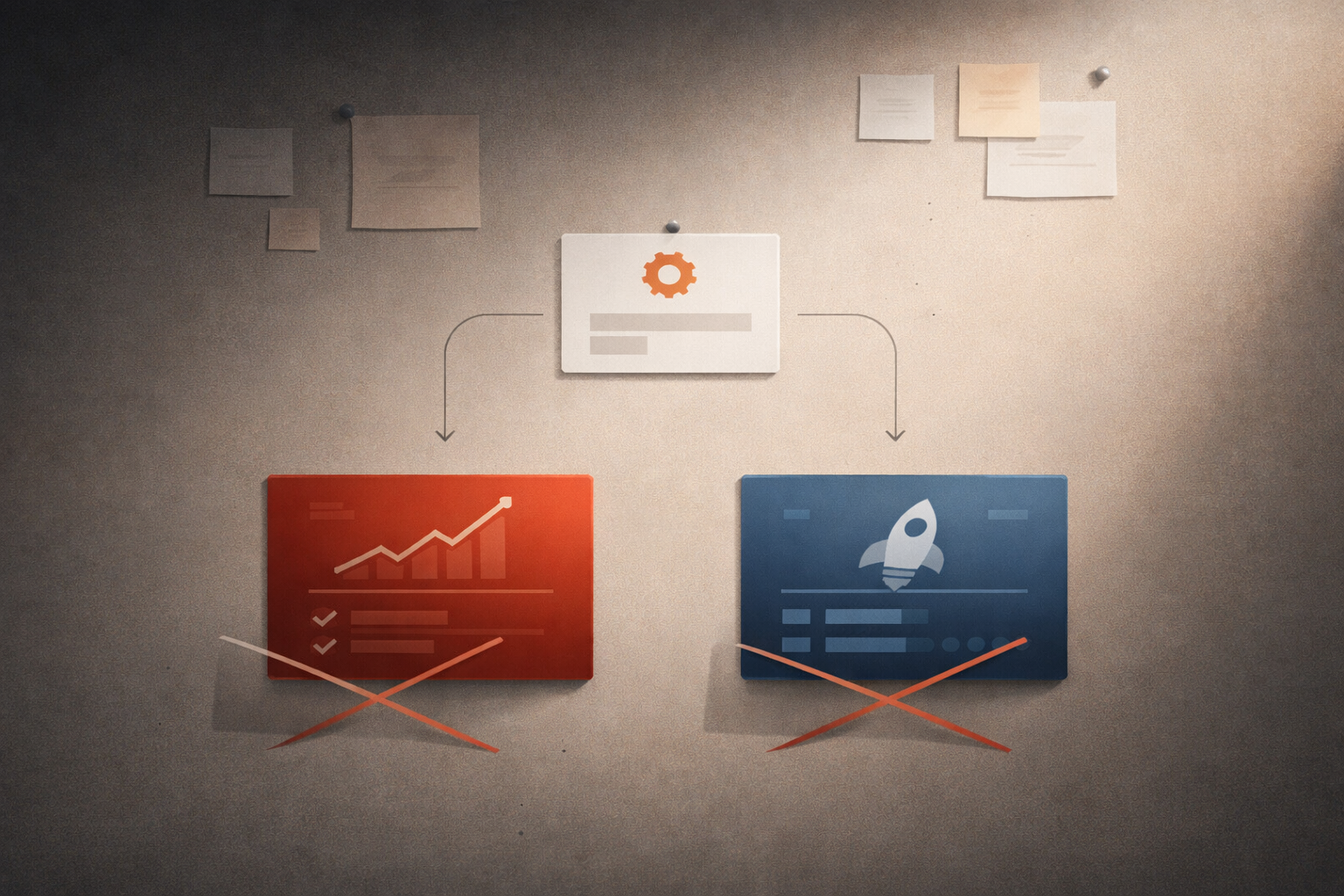
We had a version of the DojoGate roadmap where Email Sync sat at #2 and Workflow Automation sat at #4.
If you looked at either item in isolation, both felt easy to defend. A CRM should probably sync email. A CRM should probably automate repetitive work. Both sounded customer-friendly. Both sounded strategic. Both would have looked good in a demo.
They were also the wrong bets.
Email Sync was a 25 to 40 hour chunk. Workflow Automation was more like 35 to 50. Meanwhile, the activity layer that made the system usable day to day was cheaper, more foundational, and easier to build on. Once we forced the sequencing discussion instead of the feature-by-feature discussion, the answer got clearer. Email Sync moved from #2 to #10. Workflow Automation moved from #4 to #9.
That was the real decision. Not whether those features were good. Whether they deserved to absorb weeks of attention before the product had earned them.
Good ideas are not automatically good priorities.
Why this kind of work is more expensive than obvious bad work
Weak PMs kill bad ideas. Usually that part is easy.
A bad idea tends to announce itself. The rationale is thin. The user pain is vague. The upside is mostly theater. You can challenge it in one review and move on.
The expensive work is the stuff that almost makes sense.
It has a real advocate. It maps to a real request. It can be explained cleanly in a planning meeting. Nobody sounds stupid defending it. That is exactly why it survives long enough to hurt you.
I have seen this happen when teams confuse local logic with global sequence. A roadmap item can make perfect sense on its own and still be the wrong thing to do now. That is the trap. Reasonable work feels safer than dumb work, so it gets staffed faster, protected longer, and questioned later.
By the time the team realizes it was early, not urgent, the cost is already paid.
The DojoGate call was not about features. It was about order.
What made the Email Sync and Workflow Automation debate hard was not that the arguments were weak. The arguments were good.
If someone told me customers expect email visibility inside a CRM, I would agree. If someone told me automation creates leverage and makes the product feel more complete, I would agree again. That was not the issue.
The issue was that both features depended on a cleaner core operating layer than we had. If activity, follow-up, and task state are still rough, then synced email mostly creates more information without enough structure, and automation mostly speeds up a process we do not trust yet.
That was the moment where the roadmap had to stop being a list of defendable ideas and start becoming a sequence.
The more useful question became: what makes DojoGate a complete CRM in the fewest hours?
That question changed the conversation fast. It stopped rewarding the flashiest next feature and started rewarding the layer that made the product more coherent every day. That is a very different standard.
I do not think we solved that ranking with mathematical certainty. I just think we were clearly wrong to carry those two bets that high. That is usually what real PM judgment feels like to me. Not perfect confidence. Enough clarity to know what should not stay where it is.
The less glamorous work was the real leverage
The sharper scar from that period was not actually what we pushed down. It was what we pulled up.
Activity and Task Management is not sexy roadmap material. Nobody gets excited by connective tissue. It is harder to demo than sync and harder to market than automation. It also turned out to be the thing that made the rest of the system honest.
That work was estimated at roughly 10 to 15 hours, which made it cheaper than the bigger headline features and much higher leverage. More importantly, it changed the product from a set of adjacent ideas into something that could actually support daily operational use.
I kept coming back to the same uncomfortable truth: without the activity layer, the rest of the roadmap was going to start lying.
Reporting would look more complete than the system really was. Automation would fire on weak signals. Follow-up would feel organized without giving the user a dependable operating rhythm. The product would look broader while getting less trustworthy.
That is the pattern I watch for now. When a product can become more impressive or more dependable, I trust dependable first. Not because broadening is bad, but because broadening without a clean base usually creates expensive confusion disguised as momentum.
Foundation before plumbing sounds neat when you say it out loud. In practice it usually means choosing the less exciting item in the room and knowing you will have to defend that call against people who are not wrong, just early.
The second trap is work that gets easier to narrate than to justify
Another scar from the same product cycle came after the roadmap pivot.
We had deferred scope sitting there after S2 shifted toward AI features, and there were still adjacent items that could have been pulled back forward because they were easy to explain. Product Variants. Contact Dedup. Opportunity Multi-Contact. None of them were absurd. In a different sequence, some of them were probably right.
That is what made them dangerous.
When a roadmap gets disrupted, teams start wanting narrative stability. They want to point to the next few things and tell themselves the plan is back under control. Deferred scope items are especially seductive because they come with built-in justification. They were already considered. They were already smart enough to survive one planning round. Pulling them back in can feel disciplined even when it is just anxious.
I have made that mistake before. You convince yourself you are restoring order when you are really just rehydrating old obligations.
The better move was to treat sequence as the real lever and ask what the product needed next, not what the old roadmap still deserved. That kept some deferred work deferred. It also protected the team from a very common PM failure mode, where previously blessed work becomes politically harder to kill than newly proposed work.
This is one of the least glamorous parts of the job. Sometimes the work you need to kill is not a bad new idea. It is an older good idea whose moment passed.
What I listen for when good-looking work is about to overstay
I do not use a polished scoring model for this anymore. I mostly listen for a few recurring smells.
The first is when the work keeps winning one argument over and over again. Customer expectation. Competitive parity. Strategic signal. All real points. But if the same initiative keeps getting defended from different angles without anyone answering what it displaces, that usually means we are admiring the idea instead of sequencing the product.
The second is when the team starts talking about what the feature will unlock before it can explain what current weakness it resolves. That is usually a sign that we are planning from aspiration instead of constraint.
The third is political drag. The longer an idea survives, the more expensive it becomes to challenge because somebody has already attached judgment or status to it. At that point the job is not just product reasoning. It is emotional cleanup. You have to say, as calmly as possible, I understand why this still sounds smart. I still think it is the wrong bet right now.
That sentence is not elegant. It is also one of the most useful PM sentences I know.
What strong PMs are actually protecting
When I kill plausible work early, I am not just removing a line from a roadmap.
I am protecting execution bandwidth.
I am protecting trust, because teams can feel when leadership keeps feeding them attractive distractions and calling it strategy.
I am protecting momentum, because half-built almost-good work is one of the fastest ways to make a team feel busy and ineffective at the same time.
I am also protecting wedge clarity. Products usually get stronger by getting more themselves before they get broader. The fastest way to blur that is to keep adding adjacent work that can be defended one at a time and still weakens the whole sequence.
That is why I do not think the hardest PM skill is saying no in general.
I think it is saying no to work that could survive another hour of discussion and still deserve to lose.
The real job
Weak PMs kill bad ideas.
Strong PMs kill plausible ones.
They kill the work that tests well in meetings. The work with a clear advocate. The work that could absorb three weeks without anyone noticing the strategic damage until later.
That kind of judgment rarely feels heroic. Usually it feels deflating. You are the person lowering the temperature on something smart people can imagine themselves building.
But I trust that instinct more now than I used to.
Because the older I get, the less I think product management is about defending more ideas.
I think it is about protecting the team from its own cleverness.